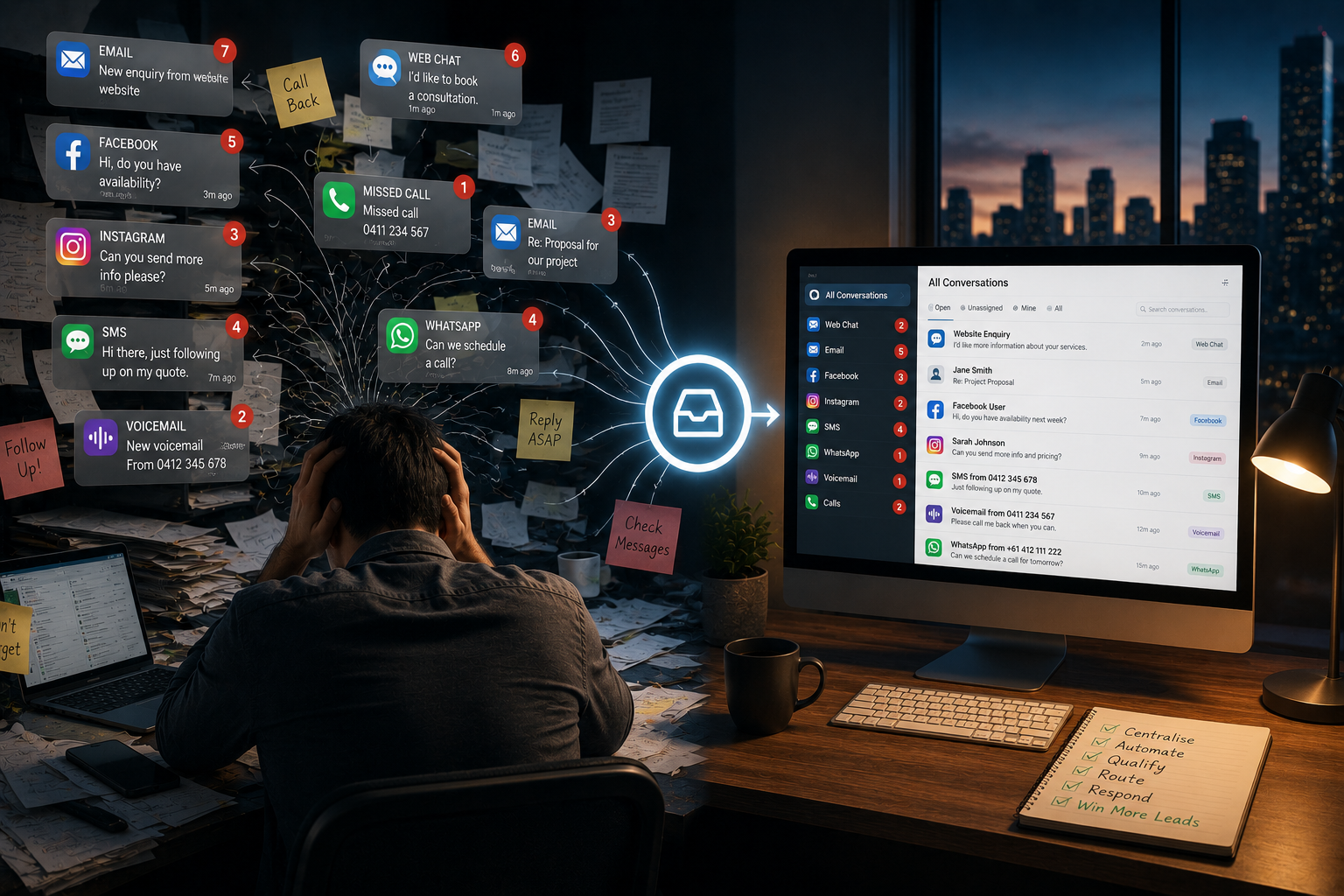
Fast replies used to be simple, but modern customers and nonstop channels have quietly raised the bar far beyond what most small teams can handle.
Keeping up with messages used to mean checking email a few times a day and returning a few calls. Now customers in Melbourne expect near instant replies on email, SMS, social media, web chat, and even voicemail. We hear the same frustration from owners again and again when they ask why small businesses can't respond fast enough anymore, even when the team is working harder than ever.
It is not that you or your staff do not care. It is that the rules of communication have changed while many of the tools and processes have not. The result is missed leads, cold prospects, and conversations that simply slip through the cracks. We want to unpack what is really going on so you can see the problem clearly and start fixing it, step by step.
Below are five surprisingly common reasons rapid responses are getting harder, and how AI customer communication and better systems can turn things around without burning your team out.
1. Conversations Are Scattered Across Too Many Channels
One of the biggest reasons why small businesses can't respond fast enough anymore is simple overload. A single day might include:
- A web form enquiry from your site - Two Facebook messages - A few Instagram DMs - Several SMS replies from a past promotion - Voicemails from people who called after hours - Emails from both new and existing clients
When all of these sit in different inboxes, apps, and phones, it is almost impossible to see the full picture in real time. Someone on your team might respond to the email, but not realise the same person also sent a message on Facebook. Another lead might text back a question, but nobody is watching that number closely that afternoon.
We see this multi channel chaos every day. It is not a people problem. It is a system problem.
2. Manual Lead Response Cannot Keep Up With Speed Expectations
Customers in Melbourne are increasingly used to getting answers in minutes. Food delivery, ride sharing, and online retail have trained everyone to expect fast replies, even from small local operators. That is another key reason why small businesses can't respond fast enough anymore. Expectations have shifted, but manual workflows have not.
A typical pattern that hurts lead conversion is:
1. A potential customer fills out a form or clicks an ad and calls. 2. You are with a client, on a site visit, or simply away from your desk. 3. By the time you return the call or email later that day, they have already spoken with someone else or lost momentum.
AI lead response changes that dynamic by sending a friendly acknowledgement in seconds, asking a simple follow up question, or offering a time to chat. Even a short, human sounding automated reply like "Got your message, we will be in touch shortly, can you tell me a bit more about X?" keeps the conversation alive and shows you are attentive.
3. Staff Are Juggling Service Delivery And Communication
In most small businesses, the same people who deliver the work are also answering messages. That might be you, your partner, or a small admin team that wears ten hats at once. On a busy day, guess which tasks get priority: the client right in front of you, or the enquiry that just pinged your inbox.
This is completely understandable, but it is also a main reason why small businesses can't respond fast enough anymore. The more successful you become, the more competing priorities you face. Without some kind of AI customer communication support taking care of first contact and simple questions, your team is forced to choose between doing the work and winning new work.
We have seen how much stress this creates. There is that constant background feeling of "Who have I forgotten to reply to today?" which is not exactly helpful for focus or peace of mind.
4. Data Lives Everywhere And Nowhere
Even when you do reply quickly, what happens next often depends on memory, sticky notes, or scattered spreadsheets. A lead might:
- Call for a quote and get pricing over the phone - Reply to a follow up SMS with a different budget - Send an email later asking to push the start date
If your notes are spread across email threads, personal phones, and mental reminders, staying on top of the full story is incredibly difficult. That disorganisation is another subtle reason why small businesses can't respond fast enough anymore. You are not just replying to a single question, you are trying to reconstruct the history of every conversation.
Modern AI lead response tools work best when they sit on top of a single organised system, where every interaction lives in one place. When a new message comes in, context is right there, so even if AI drafts the reply, it feels specific and personal, not generic.
5. After Hours Enquiries Are No Longer Optional
Once upon a time, closing the laptop at 5 pm meant the day was done. Now a large share of enquiries arrive in the evening or on weekends, when people finally have time to research and send messages. This is a final key reason why small businesses can't respond fast enough anymore. You cannot realistically staff your inbox around the clock, but customers do not stop reaching out.
Without some type of AI customer communication in place to triage and acknowledge after hours enquiries, those messages sit for 12 or 18 hours. By morning, that once warm lead has cooled. Even if you personally text back first thing, you often feel like you are already on the back foot.
With AI handling the first touch, you can still be human and present during the day, while giving people a genuinely helpful response at night. It is less about being robotic and more about extending your responsiveness beyond the limits of your own schedule.
What Effective AI Support Really Looks Like
When people hear "AI," they sometimes imagine cold, scripted chatbots that frustrate customers. That is not what we aim for at all. The kind of AI customer communication that actually helps small businesses feels more like a polite, always on assistant that knows your tone, your offers, and your typical questions.
In practice, this often includes:
- Quick acknowledgement messages when someone fills out a form, calls, or messages - Intelligent follow up questions to qualify leads without sounding pushy - Simple answers to common questions, like opening hours, pricing ranges, or service areas - Smart routing, so complex enquiries are flagged for you or your team to handle personally
You still make the key decisions. You still step in where nuance, empathy, or negotiation is needed. AI simply covers the repetitive edges where delays cost you opportunities.
Turning Missed Conversations Into A Simple System
If you recognise yourself in any of these patterns, you are not alone, and you are not failing. The environment has shifted under all of us, which is why small businesses can't respond fast enough anymore without some smarter support.
The good news is that the path forward is usually more straightforward than it looks at first. A basic roadmap often looks like this:
1. Centralise all your channels into one place so nothing gets lost. 2. Set up AI lead response for first contact and simple questions. 3. Define when you or your team step in for personal follow up. 4. Review a few conversations each week and refine the tone so it really sounds like you.
With this kind of setup, your response times drop dramatically, your team spends less time chasing scattered messages, and your customers feel looked after from the first moment.
Ready To Transform How You Respond
In our work at AKT Services here in Melbourne, we focus on making that shift from scattered, stressful communication to a clear, AI supported system that actually feels human. When you understand why small businesses can't respond fast enough anymore, the bottlenecks stop feeling mysterious, and you can finally do something practical about them.
If you are tired of missed calls, slow replies, and leads slipping away quietly, we are here to help you build something more sustainable, without losing the personal touch that makes your business yours.