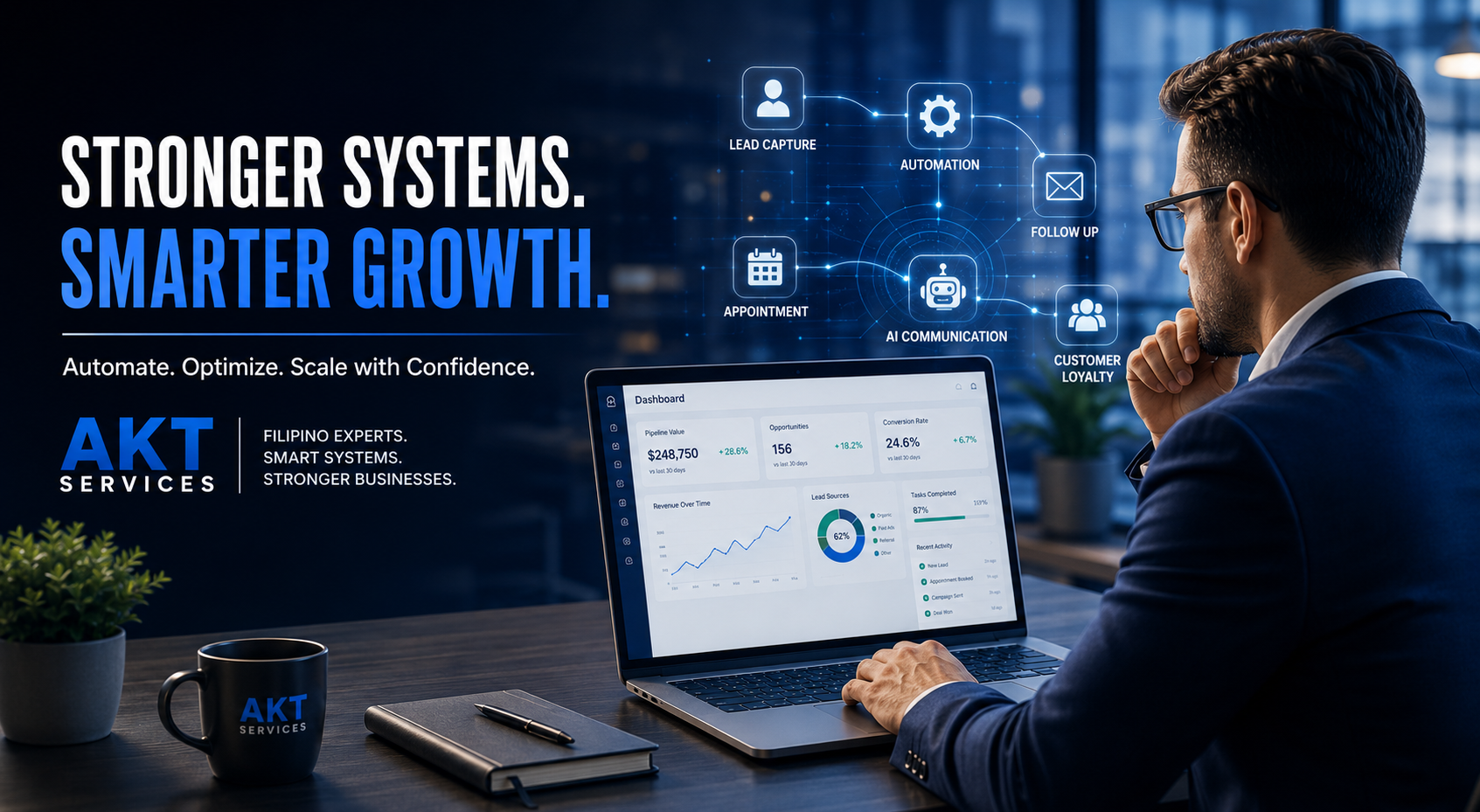
Most Businesses Don’t Actually Need More Software
They need cleaner systems.
That distinction matters more than people realize.
A lot of businesses are drowning in tools right now. One platform handles email marketing. Another handles SMS. A separate system manages appointments. Reviews live somewhere else. The CRM barely talks to the chatbot. Reporting is fragmented. Nobody fully trusts the pipeline numbers.
Then leadership starts wondering why operations still feel chaotic despite paying for five or six subscriptions every month.
This is usually the point where businesses start looking into GoHighLevel automation, CRM automation, or AI automation systems.
But there’s another problem that shows up almost immediately.
Most automation setups are built backwards.
The software gets installed first. The workflow thinking comes later.
That approach creates fragile systems very quickly.
An experienced GoHighLevel expert sees this constantly during audits. Businesses often have dozens of workflows running simultaneously, yet simple operational problems still exist underneath:
- leads sitting untouched for hours
- inconsistent follow-up timing
- duplicate records contaminating reporting
- sales reps bypassing the CRM entirely
- broken attribution tracking
- appointment no-show problems
- pipelines filled with stale opportunities
- automation conflicts triggering contradictory messages
The business technically has automation.
But operationally, things still feel messy.
That usually happens because automation without process architecture simply scales dysfunction faster.
And honestly, that has become one of the biggest hidden problems in the CRM automation industry.
The Businesses Winning Right Now Are Operationally Faster
Not necessarily bigger.
Not necessarily smarter.
Faster.
A roofing company that responds to inbound Facebook leads within 45 seconds will usually outperform a competitor responding 18 minutes later.
A med spa with intelligent appointment reminder systems will consistently reduce no-shows compared to clinics relying heavily on manual front-desk coordination.
A law firm with structured consultation nurturing workflows will convert more hesitant leads than firms relying entirely on sporadic callbacks.
Speed compounds in modern business operations.
But here’s what many companies misunderstand:
Operational speed is not just about working harder.
It is heavily tied to system design.
That is why businesses investing in AI automation systems and properly structured GoHighLevel CRM setups are starting to separate themselves operationally.
The gap becomes noticeable fast.
What a Real GoHighLevel Expert Actually Understands
A lot of people can technically build workflows inside GoHighLevel.
That alone does not make someone a GoHighLevel specialist.
Real expertise shows up in the decisions behind the workflows.
An experienced CRM automation expert understands things like:
- customer journey friction
- lead response psychology
- pipeline decay
- nurture timing behavior
- operational bottlenecks
- attribution reliability
- automation fatigue
- lifecycle segmentation
- conditional logic conflicts
- sales cycle variability
- CRM contamination risks
Those details matter far more than flashy automation diagrams.
Because automation is ultimately behavioral engineering.
The system is influencing how leads behave, how teams behave, and how information flows throughout the business.
That requires operational thinking, not just technical setup knowledge.
Why Generic Automation Templates Usually Fail
This is one of the least discussed issues in the automation space.
Templates often create unrealistic expectations.
A business owner downloads a “high-converting GoHighLevel workflow” expecting immediate transformation. The workflow imports successfully. Automations trigger. Messages send.
Yet performance barely improves.
Sometimes results even get worse.
Why?
Because automation systems are context-sensitive.
A contractor handling emergency inbound calls behaves completely differently from a consultant nurturing higher-trust discovery calls over several weeks.
A dental clinic optimizing appointment attendance has different communication priorities than a real estate business managing long-term follow-up pipelines.
Even within the same industry, operational structures differ heavily.
One roofing company may prioritize rapid dispatch. Another may prioritize insurance qualification first. Another may focus heavily on financing conversations.
The automation logic should reflect those realities.
This is where experienced AI automation agencies outperform low-cost setup providers.
They build around operational behavior instead of blindly importing templates.
The Hidden Operational Problems Most Businesses Don’t Notice
One interesting thing happens when businesses scale manually for too long.
People create invisible workarounds.
Sales reps start tracking leads privately. Staff members create side spreadsheets. Missed tasks get handled through memory instead of systems. Teams stop trusting the CRM entirely.
At that stage, the business may appear functional externally while internally running on operational duct tape.
Then automation gets introduced into unstable processes.
That creates a dangerous situation because automation amplifies whatever process already exists.
Good systems become more efficient.
Bad systems become more chaotic.
A true GHL automation specialist usually spends significant time identifying operational friction before building anything substantial.
That part is often skipped by inexperienced implementers.
CRM Contamination Is More Expensive Than Most Businesses Realize
Poor CRM hygiene quietly destroys automation quality.
Duplicate contacts. Broken tags. Incomplete custom fields. Incorrect attribution. Dead opportunities never cleared from pipelines.
These issues sound minor individually.
But together, they distort reporting, confuse automations, and reduce team trust in the system.
For example, imagine a business running AI lead generation campaigns across:
- Facebook Ads
- Google Ads
- SEO traffic
- referrals
- organic social media
- local directory listings
If attribution tracking is unreliable, the business eventually stops understanding where profitable leads actually come from.
Now marketing decisions become guesswork.
That becomes expensive quickly.
An experienced CRM automation expert understands that database cleanliness is not administrative busywork.
It directly affects revenue visibility.
The Difference Between AI Automation and Basic Automation
A lot of businesses still confuse automation with AI.
Traditional automation follows predefined logic.
Example:
“If a form is submitted, send an SMS.”
That is workflow automation.
AI automation introduces interpretation and decision-making layers.
For example:
- analyzing lead intent
- categorizing urgency
- qualifying service interest
- detecting sentiment
- generating personalized responses
- routing inquiries dynamically
- summarizing conversations
- predicting follow-up timing
This creates much more adaptive operational systems.
But it also creates new challenges.
AI systems require guardrails.
Without proper constraints, AI-powered workflows can create inconsistent customer experiences surprisingly fast.
That is why experienced AI automation experts focus heavily on system boundaries and operational safeguards.
Why Different Industries Need Completely Different Automation Architectures
This part gets overlooked constantly by generic automation providers.
Operational behavior changes dramatically across industries.
A med spa typically cares about:
- appointment attendance
- recurring bookings
- review generation
- promotional follow-up
- front-desk workload reduction
A law firm usually prioritizes:
- consultation qualification
- trust-building nurture sequences
- intake documentation
- case-type segmentation
- longer sales cycles
A roofing company often requires:
- ultra-fast inbound lead response
- geographic dispatch coordination
- estimate scheduling
- insurance workflow triggers
- weather-related urgency handling
A multi-location dental group needs entirely different CRM logic compared to a solo consultant.
That is why real operational strategy matters more than simply “building workflows.”
Lead Response Timing Is One of the Biggest Hidden Revenue Factors
Most businesses underestimate how aggressively lead intent decays.
Especially with paid traffic.
A lead searching Google for a contractor, lawyer, or clinic is usually contacting multiple businesses simultaneously.
The first business creating meaningful engagement often wins disproportionate conversion share.
Not always because they are the best.
Because they responded while urgency still existed.
This is why automated follow-up systems and AI chatbot automation have become so valuable operationally.
Not because businesses want to eliminate human interaction.
Because delayed communication destroys momentum.
A properly configured GoHighLevel automation system can:
- respond instantly
- qualify the inquiry
- trigger nurturing
- assign internal tasks
- schedule appointments
- initiate reminders
- escalate urgent requests
All before staff manually touches the lead.
That operational responsiveness creates massive competitive advantages.
Automation Fatigue Is Becoming a Real Problem
There’s another side to automation that many people avoid discussing.
Customers are becoming increasingly sensitive to robotic communication.
People can feel when a business over-automates interactions.
You see it constantly now:
- unnatural chatbot conversations
- repetitive nurture emails
- generic SMS blasts
- awkward AI-generated responses
- over-triggered reminders
Businesses sometimes become so focused on automation volume that they forget communication quality matters.
Good automation feels supportive.
Bad automation feels exhausting.
That difference often comes down to restraint.
Experienced GoHighLevel experts usually build systems that automate intelligently without overwhelming customers.
That balance matters more than people think.
Pipeline Decay Quietly Kills Revenue
One operational issue many businesses ignore is stagnant opportunities.
Pipelines slowly fill with dead leads nobody officially closes.
Sales reps stop updating stages. Follow-up timing becomes inconsistent. Reporting loses accuracy.
Eventually the pipeline stops reflecting operational reality.
That creates several downstream problems:
- inaccurate forecasting
- poor staffing decisions
- distorted marketing analysis
- false revenue expectations
- unreliable KPIs
A properly designed pipeline automation system should continuously manage opportunity health.
For example:
- stale opportunities triggering alerts
- inactivity timers
- nurture reactivation workflows
- automatic stage validation
- lead scoring adjustments
Healthy pipelines require maintenance logic.
Not just visual organization.
AI Chatbot Automation Is Improving Faster Than Most Businesses Realize
Early chatbots were frustrating because they behaved rigidly.
Modern AI chatbot systems are becoming dramatically more conversational.
But the biggest improvement is not the wording itself.
It is contextual handling.
Modern AI systems can now adapt conversations based on:
- service type
- lead urgency
- previous interactions
- CRM history
- appointment behavior
- conversation sentiment
- lead source
This changes customer experience substantially.
For example, a roofing lead after a storm should not receive the same conversational flow as a scheduled landscaping consultation.
Context matters.
Businesses that implement AI chatbot automation intelligently are starting to create significantly smoother customer experiences.
Why Multi-Location Businesses Become Operationally Complex Very Quickly
Multi-location businesses introduce another layer of CRM automation difficulty.
Now the system must handle:
- regional lead routing
- branch-specific reporting
- localized calendars
- location-specific staff
- separate review monitoring
- varying service availability
- geographic attribution tracking
Without clean operational architecture, scaling becomes messy extremely fast.
One issue that appears frequently in multi-location systems is lead ownership confusion.
A lead enters centrally. Nobody knows which branch should handle it. Response timing slows down. Follow-up quality drops.
These are operational design problems more than software problems.
And they require strategic workflow planning, not generic automation templates.
The Businesses Seeing the Strongest Results From AI Automation
Interestingly, the strongest automation outcomes usually happen in businesses with repetitive communication patterns.
Examples include:
- service businesses
- agencies
- healthcare providers
- home services
- consultants
- local businesses
- real estate operations
These industries deal heavily with:
- inquiries
- scheduling
- reminders
- follow-up
- qualification
- status updates
- recurring communication
That operational repetition creates strong automation opportunities.
But again, effectiveness depends heavily on implementation quality.
Why Internal Operations Automation Is Often More Valuable Than Marketing Automation
Marketing automation gets most of the attention because it is visible.
Internal operational automation often creates larger long-term efficiency gains.
Things like:
- task routing
- technician dispatch logic
- onboarding coordination
- approval workflows
- internal notifications
- escalation handling
- project status automation
- reporting synchronization
These systems reduce operational drag across the organization.
The businesses scaling most efficiently usually have strong internal workflow automation infrastructure behind the scenes.
Customers rarely see it directly.
But they absolutely feel the operational consistency it creates.
The Future of CRM Automation Is Moving Toward Operational Intelligence
Older CRM systems mainly stored information.
Modern systems increasingly make operational decisions.
That shift is accelerating.
We are already seeing AI-powered systems capable of:
- predicting lead quality
- prioritizing follow-ups
- generating personalized responses
- summarizing conversations automatically
- detecting churn risks
- identifying bottlenecks
- optimizing nurture timing
- routing conversations intelligently
The businesses adapting early are building operational advantages that become difficult to replicate later.
Because over time, better systems create better data.
Better data improves automation quality.
Improved automation quality creates stronger customer experiences.
That cycle compounds.
What Businesses Should Actually Look For in a GoHighLevel Expert
Not flashy dashboards.
Not giant workflow screenshots.
Operational thinking.
A real GoHighLevel specialist should understand:
- customer behavior
- sales process design
- operational bottlenecks
- CRM architecture
- lifecycle management
- reporting reliability
- automation psychology
- scalability constraints
Because ultimately, automation systems are operational infrastructure.
Not just marketing accessories.
That distinction matters heavily once businesses start scaling seriously.
Frequently Asked Questions
What does a GoHighLevel expert do?
A GoHighLevel expert designs and optimizes CRM systems, automation workflows, lead nurturing sequences, pipeline structures, AI chatbot systems, appointment booking flows, and operational automations inside the GoHighLevel platform.
What is CRM automation?
CRM automation refers to using software and workflow systems to automate tasks like lead management, follow-up communication, appointment scheduling, customer tracking, pipeline updates, and operational processes.
How does AI automation improve business operations?
AI automation helps businesses respond faster, qualify leads intelligently, automate repetitive communication, improve customer experience consistency, and reduce manual operational workload.
Why do many automation systems fail?
Most automation systems fail because businesses automate broken processes, ignore CRM hygiene, overcomplicate workflows, or rely heavily on generic templates that do not match their operational reality.
Is GoHighLevel good for agencies?
Yes. GoHighLevel is widely used by agencies because it centralizes CRM management, workflows, automation, messaging, pipelines, appointment systems, and reporting into one platform.
Can AI chatbots book appointments automatically?
Yes. Modern AI chatbot automation systems can qualify leads, answer questions, synchronize with calendars, schedule appointments, send reminders, and escalate conversations when human intervention is needed.
Final Thoughts
Businesses are entering a period where operational responsiveness matters almost as much as product quality.
Customers increasingly expect:
- faster replies
- smoother communication
- organized follow-up
- easier scheduling
- consistent experiences
The companies operating efficiently behind the scenes are quietly building major competitive advantages.
Not because they necessarily work harder.
Because their systems reduce friction.
That is the real value of intelligent GoHighLevel automation and AI-powered CRM systems.
Not flashy workflows. Not endless automations.
Operational clarity.
And businesses that treat automation as infrastructure instead of just software usually scale much more sustainably over time.