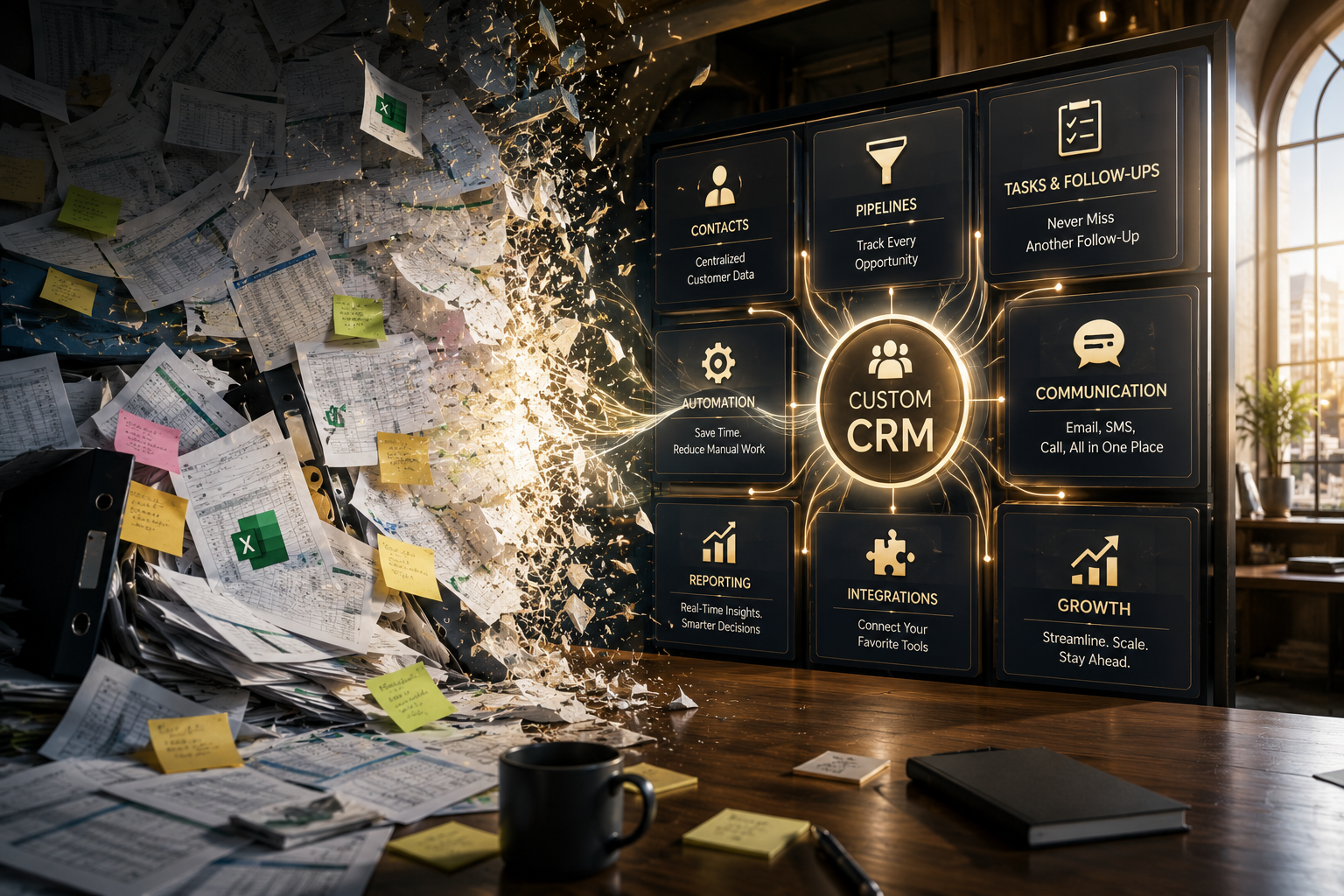
When your spreadsheets start running your day instead of the other way around, it is time to rethink your systems.
Spreadsheets are wonderful for getting started. They are fast, flexible, and familiar. For many small US businesses, a few shared sheets feel like a clever, scrappy solution that keeps everything in one place. We see this all the time when we first talk with new clients. At some point though, those same spreadsheets that once felt empowering start to feel fragile and a little bit scary.
We work with business owners who are juggling leads, projects, invoices, team notes, and follow ups across a maze of tabs. There is usually one person who knows which color code means "hot lead" and which one means "waiting on contract," and if that person is out for a day, everyone else hesitates. That is the quiet moment when a lot of people realize the tools that got them here might not get them where they want to go next.
In this article, we are going to walk through 5 Signs Your US Business Has Outgrown Spreadsheets and Needs a Custom CRM. You will see how to recognize those signs in your own day to day operations, what a custom CRM can actually do that spreadsheets cannot, and how a CRM builder and GoHighLevel expert can help you move from "patchwork" to "predictable" without blowing up your existing processes overnight.
Why Businesses Start With Spreadsheets (And Why That Stops Working)
We completely understand why spreadsheets are usually the first system a business adopts. They are cheap, flexible, and nearly everyone on your team already knows how to use them at a basic level. It feels smart to keep things simple and avoid heavy software when every dollar and minute counts.
Over time, though, a spreadsheet starts collecting roles it was never truly designed for. It becomes:
- A lead tracker - A light CRM - A project dashboard - A billing tracker - A team communication log
At a certain scale, that "one tool for everything" approach turns fragile. There is no built in automation, no safeguards, no standard workflows, and no real visibility into the health of the business beyond what someone manually pieces together. That is where the 5 Signs Your US Business Has Outgrown Spreadsheets and Needs a Custom CRM tend to show up clearly.
Sign 1: You Are Living In Data Chaos And No One Trusts “The Latest Version”
One of the earliest and clearest 5 Signs Your US Business Has Outgrown Spreadsheets and Needs a Custom CRM is simple: no one is really sure which spreadsheet is correct anymore.
We hear variations of the same story again and again. There are files named "Client List FINAL," then "Client List FINAL2," then "Client List REAL FINAL." Someone exports a CSV from a platform, someone else adds columns manually, and suddenly there are three versions of the truth.
This data chaos looks like:
- Hunting through email or chat trying to find the latest file attachment - Realizing during a call that the lead information in your sheet is weeks out of date - Having different team members update different copies of the same sheet - Spotting formula errors only after they have affected reports or forecasts
When there is no single source of truth, your team moves slower because they double check everything. That hesitation is a cost. A custom CRM becomes the place where data lives permanently, not in a loose file on someone's desktop. A CRM builder can configure your system so contacts, deals, tasks, and notes exist in one place, with proper permissions and clear update histories. That means any team member can log in and trust what they see.
Sign 2: Leads And Customers Are Slipping Through The Cracks
Another major sign in the list of 5 Signs Your US Business Has Outgrown Spreadsheets and Needs a Custom CRM is that follow ups feel random. You might have great intentions about staying on top of leads, but the tools make it hard.
In a spreadsheet based setup, follow up is usually managed with:
- Color coding rows to indicate lead status - Adding dates in a column like "Follow up date" - Filtering by those dates when someone remembers - Manually sending emails and updating statuses
This works only as long as volume is low and your attention is high. As your US business grows, it becomes almost impossible to remember who needs a call today, who should receive a nurture email next week, and who requested a proposal last month.
A custom CRM changes that dynamic completely. Instead of asking your brain to remember every next step, you design automated workflows that do the remembering for you. A GoHighLevel expert can build sequences such as:
- When a new lead submits a form, automatically tag them, send a welcome email, and create a follow up task for your team. - If a quote is sent but not accepted within 5 days, trigger a gentle reminder email and a prompt to check in by phone. - When a client project is completed, move the contact to a post project nurturing pipeline so testimonials and referrals are requested consistently.
In a spreadsheet, each of those steps is an extra manual action that may or may not happen. In a CRM, they are simply part of the structure. That shift alone often produces a noticeable uptick in conversion rates and customer satisfaction, even before you change anything about your messaging.
Sign 3: Reporting Takes Hours And Still Feels Incomplete
If you dread the end of the month because it means spending hours cobbling together numbers from different sheets, that is another of the 5 Signs Your US Business Has Outgrown Spreadsheets and Needs a Custom CRM.
Reporting inside spreadsheets usually means:
- Manually exporting data from different tools - Cleaning up messy columns and inconsistent formats - Creating pivot tables or summary tabs by hand - Hoping no one breaks a cell reference the day before a meeting
It is stressful, and it often leads to narrow questions like "How many leads did we get?" or "What was revenue last month?" Your ability to dig deeper is limited by how much time you can spend building formulas and charts.
With a custom CRM, you can get dashboards that show:
- Lead sources and which ones bring in the highest value customers - Close rates by sales rep, pipeline stage, or product type - Response times and their impact on conversion - Lifetime value and retention trends
A CRM builder can translate the questions you care about into live dashboards that update automatically. Instead of "I think our close rate is around 20 percent," you can say "We are currently closing 27 percent of qualified leads, and leads from source X close at 35 percent." Decisions become more grounded because you are not guessing from memory or piecing together stale snapshots of data.
Sign 4: Your Team Keeps Building Workarounds To Survive
Another of the 5 Signs Your US Business Has Outgrown Spreadsheets and Needs a Custom CRM is when you notice how many little workarounds your team has invented just to keep functioning.
We see all kinds of creative solutions:
- Separate "to do" columns in spreadsheets so people can assign tasks to one another - Long comment threads inside cells, where notes are easy to miss - Manual email templates saved in Word or Google Docs instead of inside a system - Extra tabs acting as inboxes for new leads or support requests
These hacks are clever, but they are fragile. They break the moment someone new joins the team or volume spikes. It is like building a house out of stacked boxes. It can technically stand, but nobody really relaxes inside.
A custom CRM gives you structures that are meant to hold real operational weight:
- Task and pipeline management that assigns, tracks, and escalates work - Centralized email and SMS templates tied to specific actions - Shared calendars and appointment booking that sync with your pipelines - Internal notes and mentions that sit right on the customer record
Working with a GoHighLevel expert, you can actually map the messy real world workflows your team is using today and turn them into clean, repeatable processes inside the system. That means fewer Slack messages saying "Did anyone follow up on this?" and more quiet confidence that your setup is doing what it should, even when you are not watching it constantly.
Sign 5: You Are Ready To Scale But Your Systems Are Holding You Back
The final item in the 5 Signs Your US Business Has Outgrown Spreadsheets and Needs a Custom CRM is usually more of a feeling than a specific error message. You can see the growth potential, but every time you imagine doubling or tripling your customer base, your current systems seem like the bottleneck.
Typical worries include:
- "If we get more leads, we will drop the ball because we cannot track them properly." - "Onboarding new staff is hard because so much is in people's heads or scattered sheets." - "We cannot easily see which offers or campaigns work best, so scaling our marketing feels risky."
When your gut says, "We are capable of more, but the way we track and manage work is maxed out," that is a strong sign it is time for a custom CRM. The right system does not just replace your existing sheets. It creates a framework you can layer growth on top of.
With the help of a CRM builder and GoHighLevel expert, you can:
- Standardize stages for leads, deals, and projects so everyone speaks the same language - Automate repetitive admin tasks, freeing your team for higher value work - Integrate key tools (email, phone, invoices, forms, calendars) so information flows in one direction instead of ten - Set up permission based access so sensitive information is secure as your team grows
Scaling then becomes a matter of adding capacity to a well designed framework, not reinventing your process every few months.
Why A Custom CRM Beats A Generic “Out Of The Box” Setup
It is worth pausing here, because some people assume that "CRM" just means turning on a new piece of software and trying to fit their business into it. That is not what we are talking about.
The real power of moving beyond the 5 Signs Your US Business Has Outgrown Spreadsheets and Needs a Custom CRM lies in tailoring the system to the way you actually work.
A custom CRM should reflect:
- Your terminology for leads, opportunities, deals, and clients - The specific stages your prospects and customers move through - The exact touchpoints you use, like calls, emails, SMS, or in person meetings - The internal handoffs between sales, onboarding, account management, and support
When we work with clients inside GoHighLevel, we do not just "turn things on." We look at those messy spreadsheets, listen to how your team actually describes the work, and then design pipelines and automations that match. The result is a system that feels familiar but far more powerful.
It is a bit like moving from a crowded desk full of sticky notes and notepads into a clean, organized workspace where everything has a place. The work itself may be the same, but your capacity and clarity open up.
How To Know If You Truly Need A Custom CRM (And Not Just Better Sheets)
It is completely fair to ask whether you really need a custom CRM yet. Not every business is ready this second. Here are some questions that can help, framed around the 5 Signs Your US Business Has Outgrown Spreadsheets and Needs a Custom CRM:
1. Are you tracking more than 50 active leads or customers at any one time? 2. Does at least one team member spend more than 5 hours per week just updating or fixing spreadsheets? 3. Have you lost at least one opportunity in the last month because someone forgot to follow up or did not have the right information handy? 4. Does reporting require more than one or two manual steps to answer basic questions like "Where did this lead come from?" or "What is our current pipeline value?" 5. When you think about hiring more staff or launching a new offer, do you worry more about "Can our systems handle it?" than "Can we do the work?"
If you are nodding along to several of these, it is a strong indicator that the 5 Signs Your US Business Has Outgrown Spreadsheets and Needs a Custom CRM apply to you right now. At that point, trying to perfect your sheets is usually just delaying the inevitable migration and making it more complicated later.
What Working With A CRM Builder And GoHighLevel Expert Actually Looks Like
There is sometimes a quiet fear that implementing a CRM will be overwhelming, expensive, or disruptive. We want to demystify that a bit because the process can actually be very manageable and even a little satisfying when done thoughtfully.
Here is a simple overview of how we typically guide clients through it:
1. Discovery and mapping We start by looking at your existing spreadsheets, tools, and workflows. We talk about what is working and what is constantly breaking. This is where we identify which of the 5 Signs Your US Business Has Outgrown Spreadsheets and Needs a Custom CRM are most pressing for you.
2. Design and planning Using that information, we outline pipelines, custom fields, tags, automations, and permissions that will make your day to day easier. As a CRM builder and GoHighLevel expert, we are able to translate your operations into technical setups without forcing you to speak in software jargon.
3. Building and integration We configure your GoHighLevel account according to the plan, connect it to your forms, calendars, phone system, and email, and make sure data flows correctly. This is also where we carefully import your spreadsheet data so your historical information is preserved and usable.
4. Testing and refining Before you fully switch over, we run tests. We check that leads enter the right pipelines, automations trigger correctly, and reports show what you need. Any friction you or your team notice gets adjusted here so you are not fighting the system later.
5. Training and handover Finally, we walk you and your team through the new flows. This is often the moment where small lights go on for people: "Oh, I do not have to remember to send that follow up email anymore. It is just built in now." That is a good feeling.
The result is not just a new tool. It is a calmer day, fewer "Did anyone do X?" questions, and clearer numbers about how the business is performing.
Common Concerns About Moving Off Spreadsheets
Even when business owners can clearly see the 5 Signs Your US Business Has Outgrown Spreadsheets and Needs a Custom CRM, it is natural to hesitate. We hear the same worries often, so let us address a few.
- "We are not that big yet. Is this overkill?" The right time to set up a CRM is usually when your systems are showing strain but not completely collapsing. Waiting until everything feels chaotic makes the transition harder. Even lean teams benefit from clarity and automation.
- "My team is not very tech savvy." A well designed custom CRM can actually feel easier to use than your current patchwork of sheets and tools. The key is building views and processes that match what people already do, not ask them to memorize a new language.
- "I am afraid we will lose data in the move." Careful planning and step by step migration greatly reduce that risk. We map fields, run small test imports, and verify records before switching fully. The goal is that your historical data feels more accessible, not less.
- "What if we need to change things later?" A custom CRM in GoHighLevel is highly adaptable. As your US business evolves, we can add new pipelines, tags, and automations. You are not stuck with whatever we design on day one.
These concerns are completely reasonable. Taking them seriously is part of what makes the transition successful rather than stressful.
Practical Benefits You Will Feel In Daily Operations
Sometimes big system changes are talked about only in abstract terms like "efficiency" or "optimization." Those matter, but we also like to focus on the small day to day improvements you will actually feel, especially once you respond to the 5 Signs Your US Business Has Outgrown Spreadsheets and Needs a Custom CRM.
Here are a few examples:
- You open one dashboard in the morning and instantly see new leads, active deals, and tasks due today, instead of opening five different spreadsheets. - When you are on a call, you can see the entire history of interactions with that contact, including which emails they opened and what pages they visited, right in front of you. - New staff can be productive faster because the process is inside the system, not spread across random documents and tribal knowledge. - Follow ups that used to fall through the cracks just happen, because the system triggers them on schedule. - You can answer questions like "How many leads did we get from last month’s webinar and how many converted?" in a few clicks.
These are not dramatic movie moments. They are the quiet, practical shifts that make running your business feel more under control and less reactive.
Key Advantages Of Moving Beyond Spreadsheets
To make things easier to digest, here is a quick summary of the main advantages you gain when you act on the 5 Signs Your US Business Has Outgrown Spreadsheets and Needs a Custom CRM:
- Centralized data and single source of truth All contacts, deals, notes, and activities live in one secure place, instead of scattered files.
- Consistent follow up and automation Routine tasks and communications run on predefined rules instead of memory and sticky notes.
- Clear, real time reporting Dashboards show you what is happening now, not what happened weeks ago when you last cleaned a sheet.
- Better team coordination Tasks, handoffs, and internal notes are tracked clearly, reducing miscommunication and repeated work.
- Scalability and flexibility As your US business grows, you can add new pipelines, offers, and automations without rebuilding everything from scratch.
All of these add up to a business that is easier to run, easier to grow, and easier to step away from occasionally without worrying that everything will fall apart in your absence.
Ready To Transform How You Work Every Day
Effective systems are what quietly support every confident decision you make. When your tools are fighting you, that confidence is hard to hold onto. When your tools are aligned with the way you operate, growth feels less like a risk and more like a natural next step.
We have built our services at AKT Virtual Assistant Services around helping you make that shift in a practical, grounded way. Instead of just handing you software and wishing you luck, we step into the details of your actual workflows, translate them into a custom GoHighLevel setup, and walk with you as your team adopts it.
If you are seeing one or more of the 5 Signs Your US Business Has Outgrown Spreadsheets and Needs a Custom CRM, you do not have to wait for a crisis to act. You can choose to upgrade your systems on your own terms, in a thoughtful, guided way that respects the work you have already done and sets up your next stage of growth.